The notebook
At first glance, tabletop football — the physical classic or its digital version — looks like a simple pastime: aim, flick, celebrate or grumble. But under that simplicity hides a small gymnasium of skills that educators chase with far duller games. None of these lessons needs an adult to explain it; the game teaches them by itself. Here are the five we like most.
Every shot is an angle problem: where on the ball do I strike so it goes there? Is the direct path enough, or do I need the bounce off the wall? Kids who play aiming games develop an intuitive geometry — angle in, angle out, just-right force — years before they meet a protractor at school. Billiards has boasted this virtue for centuries; tabletop football is its little brother with goals.
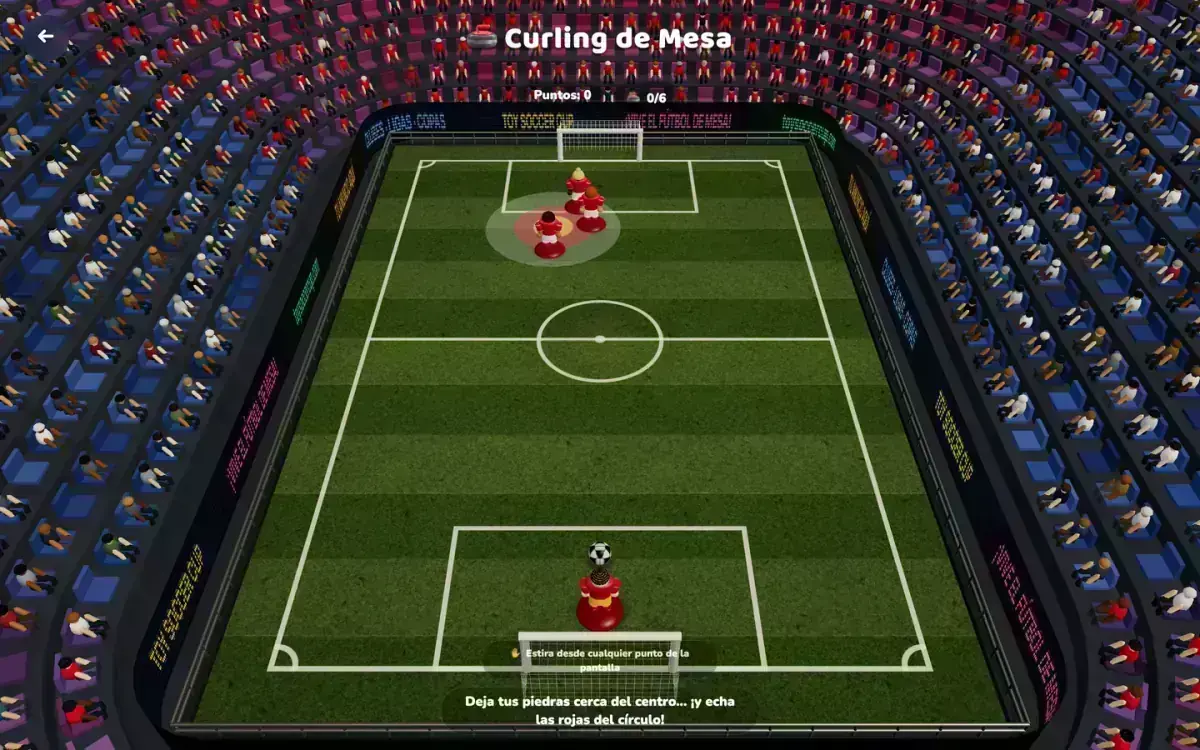
In tabletop football you do not play when you feel like it: you play when it is your turn. For a five- or six-year-old, waiting while the rival shoots is a serious exercise in self-control — and unlike a grown-up's "just wait", here the wait has visible meaning: watching the other's shot is information for your own. Turn-based games teach waiting WITHOUT disconnecting, which is precisely the skill later called attention.
Frustration is the star subject. A missed open goal, a comeback suffered on the final turn — tabletop football produces constant, low-intensity micro-defeats, which are the best possible training: they hurt just enough to learn from and little enough to want another game. The key word is "rematch": in tabletop football losing is never the end, it is the prologue to the next match. Adults can help with a single word — "again?" — said quickly, before the sting crystallises.
The slingshot gesture — rest, tense millimetre by millimetre, release — is fine motor skill in its purest form: the same family of precise movements as handwriting, drawing or musical instruments. The physical version adds the real touch of the figure; the digital one, force control on a screen. In both, the lesson is identical: harder is not better — power without control smashes the ball into the wall, and that force-to-result calibration is one of the first times a child experiences the word "precision" in their own body.

Few activities let a six-year-old, a forty-year-old parent and a seventy-year-old grandmother genuinely play — competing, not pretending. Tabletop football is one of them: it demands no teenage reflexes and no strength, only a steady hand and cunning, and with a small homemade handicap the age gaps dissolve. That mix is gold: children play FAR better than they play alone when competing against someone they admire. And the stories that come out of it ("grandma scored three past me") are instant family heritage.
None of this requires signing up anywhere: a table and something that rolls will do — or, in digital form, a browser and five minutes. In Toy Soccer Cup we have always wanted it exactly so: short matches, clear turns, instant rematches and room for the whole family on the same felt. The lessons come on their own; the kids just notice they are having fun — which is how everything is best learned.