The notebook
There is a question that sounds trivial and is not: who invented tabletop football? Ask in Stuttgart and the answer is Carl Mayer. Ask in São Paulo and it is Geraldo Décourt. Ask anywhere in Spain and nobody will name anyone, because there it was never invented — it was simply always there. Ask in Kent and they will say Peter Adolph.
They are all right. Between 1921 and 1947, in five places that barely knew of each other, people arrived at the same idea: football is too big for a house, so shrink it until it fits on a table and let a finger do the kicking. What follows is that map.
The oldest of the five is German. In 1921 the Stuttgart furniture maker Carl Mayer patented the mechanism; in 1924 the Schwenningen exporter Edwin Mieg bought the licence and turned it into Tipp-Kick: a metal figure with a hinged leg and a button on its head. You press the button, the leg swings, the ball flies. The ball is not round but a cuboctahedron — fourteen faces, six squares and eight triangles — half white and half black, so that when it stops you can see instantly which colour is up and who gets possession.
That detail says everything about the German approach: the problem was not "how do I make football small" but "how do I make football small and unambiguous". Tipp-Kick turned a hundred years old in 2024 and is still manufactured.

Six years later and an ocean away, Geraldo Cardoso Décourt started playing with the buttons off his coats and shirts. That is literally where the name comes from: futebol de botão, button football. Wooden buttons first, then plastic, then acrylic discs machined to a tenth of a millimetre.

Brazil did something none of the other four managed: it made it a sport. There are state federations, official championships, a national body, and a workshop culture where players file and polish their own discs and inherit them from their parents. Elsewhere tabletop football is a toy that ends up in a cupboard. In Brazil it is heritage with a rulebook.
Spain's version has no inventor because it has no manufacturer. Las chapas are bottle caps: you flatten them with a stone, glue in a footballer's face cut from a magazine, and flick them with an index finger levered against the thumb. The pitch is chalk on the ground. The cost is zero, which is exactly why it spread through every schoolyard in the country.
It did get organised, though, and far earlier than anyone assumes. A 2024 academic study of the Barcelona press found a Club Venjonbol meeting at the Café Tívoli, and La Publicitat announcing a «Campionat de Venjonbol (Futbol de saló)» on 13 November 1929. The first championship ran on Tuesday and Friday nights at ten o’clock, in two groups plus a promotion group, open to women, in front of a paying public — the finals were reported in the Diario de Barcelona of 18 December 1929. Spain was not late to this at all: it was competing five years after Tipp-Kick and in the same year Décourt started in São Paulo. A game made of rubbish, with a federation.

Peter Adolph took the homemade idea and turned it into a product. Subbuteo put the figure on a hemispherical base so that it wobbles when struck — teeters, threatens to fall, recovers — and laid it on green felt. Then he did the clever part: he sold the teams separately. Hundreds of kits in little boxes, waiting to be completed.
Subbuteo is the one that travelled furthest, and the one that suffered most when consoles arrived in the nineties. It came back with the pandemic, when a lot of people opened cupboards they had not opened in thirty years. There are active leagues again in Kent, and an Asian Cup played in Sydney.
The least known branch is the Eastern European one, usually called sectorball. The pitch is divided into zones, and the rules govern which of your pieces may act depending on where the ball sits. It is the most abstract and the most strategic of the five — closer to chess than to a playground scuffle.
All five agree on the essentials. The ball moves only when a piece hits it. There are no dice and no cards: the outcome depends entirely on how well you control the force and angle of your own hand. And they are all turn-based, which is why a six-year-old and a forty-year-old can play as equals — skill here is not inherited, it is trained.
They split on the piece. Germany chose a mechanism, Brazil a disc, Spain whatever the bar threw away, England a wobbling figure. And that choice changes everything: a Tipp-Kick figure kicks, a button slides, a cap skids, a Subbuteo figure nudges. Four different physics, four different sports.
If you go looking for any of this online, you will hit a wall of ambiguity. In Spain futbolín means foosball, not chapas. In France baby-foot is foosball too. In Germany Kicker is foosball. In Italy calcio balilla is foosball, while calcio da tavolo is the flick game. The same word points at two different tables depending on the country. When searching, add the year or the inventor and the noise disappears.
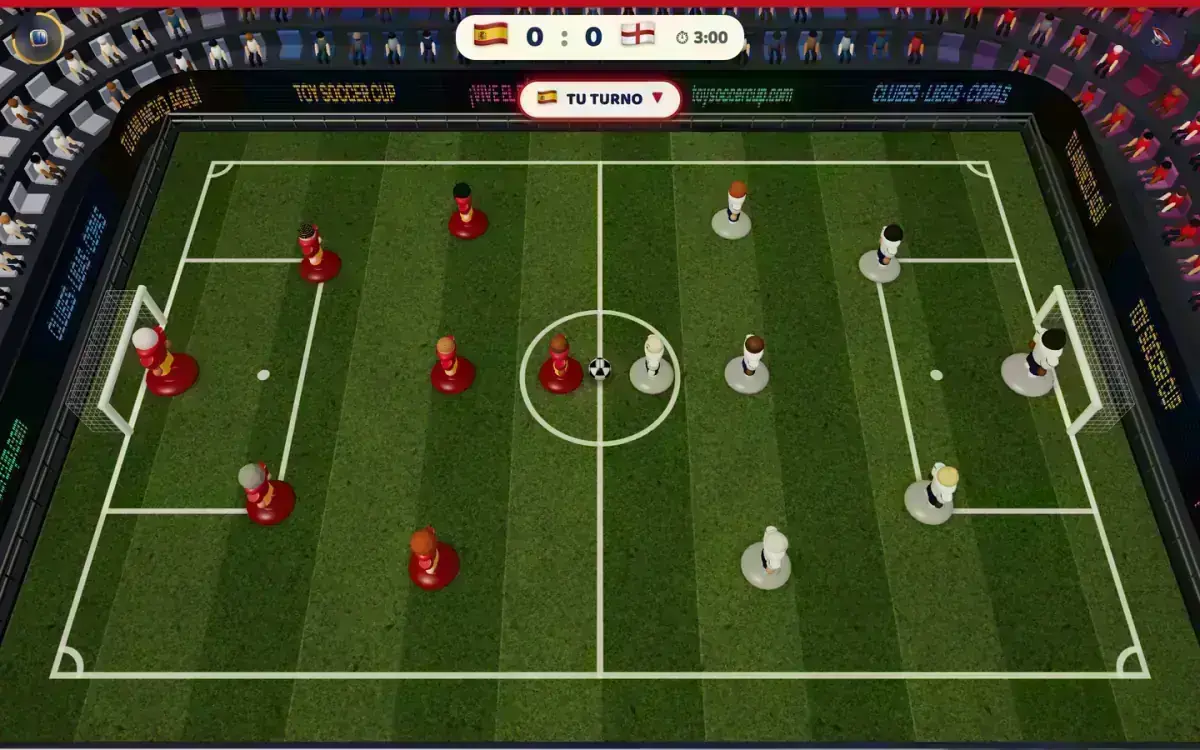
The generation that played all five grew up, and some of them make games now. The digital heirs keep what mattered — the dry flick, the felt, the collection, and the rematch as the engine that never stops. Toy Soccer Cup belongs to that family: base-mounted figures, honest physics, and leagues from all over the world, free in your browser with nothing to download.
But if this map has stirred something, do the better thing first: ask at home. There is a decent chance somebody still has a box of caps, buttons or little green figures in a cupboard, and that box is worth more than any screen.
A correction made in August 2026: this page used to date the Spanish branch to a 1945 championship in Huelva, which I could not verify anywhere. The organised Spanish game is documented sixteen years earlier, in Barcelona, by the study linked above. Tell me if you have a source that supports the Huelva date — I would like to see it.