The notebook
Every version of tabletop football — Spanish bottle caps, Brazilian buttons, German Tipp-Kick, English Subbuteo — shares the same physics, which means the same five techniques work in all of them. None takes longer than ten minutes to get a feel for.
Hit the piece off its centre instead of dead on. It spins as it slides, and a spinning piece bends. Hit the left side to curve right, the right side to curve left. This is the trick that turns a blocked shot into a goal, and it is the first one worth practising because everything else builds on the same idea.
Aim at the side wall — or the edge of the table, or a book laid on its side — and let the piece come back on an angle. Beginners only ever shoot in straight lines. The moment a child realises the walls are part of the pitch, the game gets twice as big.
The rule of thumb is the same as in billiards: it leaves at the mirror of the angle it arrives at.
Instead of one enormous shot at goal, move the ball with three soft touches and shoot from close range. It feels slower and it wins more, because a soft touch is far more accurate than a hard one and every extra metre is a chance to miss.
Hit low and flat, right at the base of the piece rather than the top. The shot stays down and travels in a straight, fast line. A high, lifted hit is spectacular and lands anywhere.
With bottle caps this is the difference between a cap that skips and one that runs true.
A defensive one, and the hardest for children to accept because it is not fun to practise. Instead of chasing the ball, place one of your pieces between the ball and your goal and leave it there. Most goals at beginner level go through empty space, not past a defender.
Ask a child to spend one whole match defending only and they will complain — and win the next one.
Set a target — a cup on its side, a gap between two books — and take twenty shots at it. Twenty. Then change the surface and take twenty more. That is the entire training routine, and it works better than playing matches because a match only gives you a handful of meaningful shots.
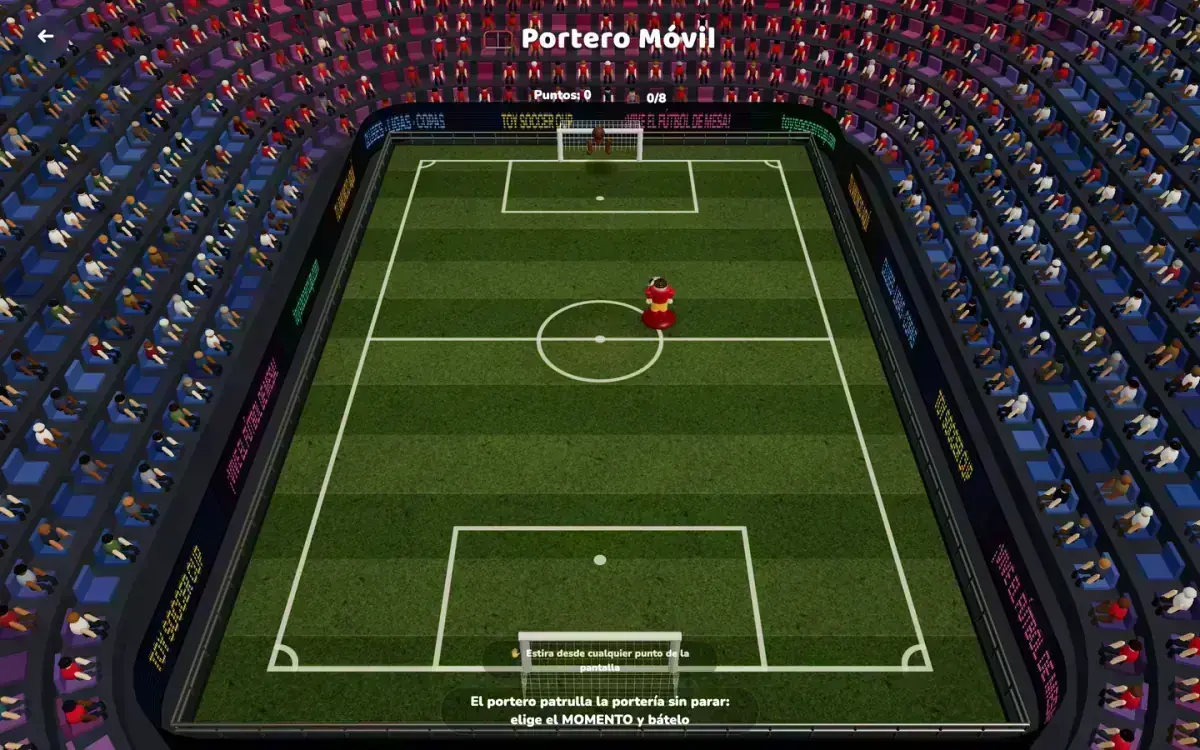
If you want somewhere to practise without setting anything up, Toy Soccer Cup runs in a browser and every pitch has a different friction, which is a fast way to feel how much the surface changes each of these five.