The notebook
Tabletop football is the rare game where the whole rulebook of physics fits in three questions: how hard you hit it, which way you hit it, and what it is sliding on. Everything a good player does is one of those three, done well.
Push harder and the piece leaves faster. That part is obvious to any child. The part that is not obvious is that it does not travel twice as far when you hit twice as hard — friction eats speed the whole way, so a very hard flick mostly buys you a fast start and a piece that ends up off the table.
The useful thing to teach is the opposite of instinct: most missed shots are hit too hard, not too soft.
Hit the piece dead centre and it goes straight. Hit it off-centre and it spins as it slides — and a spinning piece curves. That is the whole secret behind every trick shot in every version of this game, from bottle caps to acrylic discs.
A good way to show it to a child: put a piece on a table, hit it exactly in the middle three times, then hit it near the edge three times. They will see the curve before you finish explaining it.
This is the one adults underestimate. The same flick on a polished table, on felt and on carpet gives three completely different games. Wood is fast and slippery — long passes, hard to stop. Felt is medium and predictable, which is exactly why every commercial version of this game sits on felt. Carpet is slow and grabby: short passes, and precision matters more than power.
If you play at home, this is the cheapest way to change the game entirely: play the same match on the kitchen table and then on the rug.
Because nothing is hidden. There are no dice, no cards and no invisible statistics deciding anything. A child does something, sees the result immediately, adjusts, and tries again — which is the scientific method with a ball.
And because the feedback is fast. A shot takes two seconds. In ten minutes a child performs more experiments than a whole afternoon of school science.
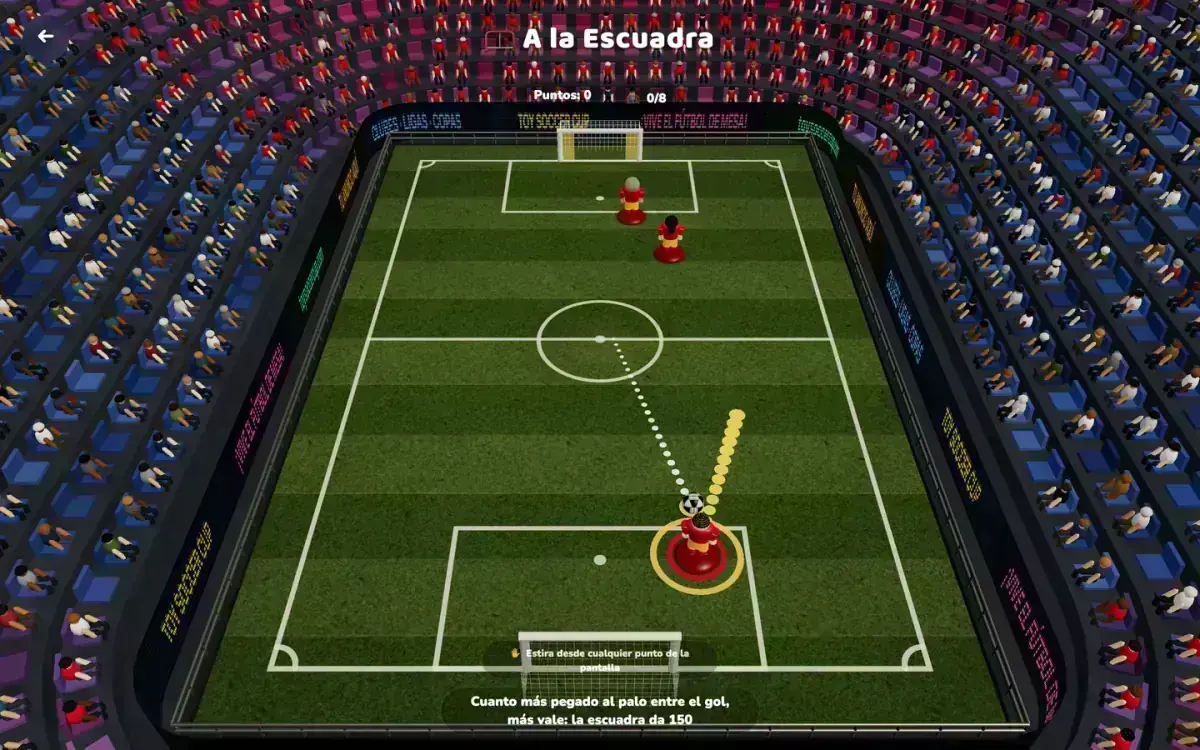
A digital version has to model the three or it feels wrong. In Toy Soccer Cup the pull-back length is force, the direction is angle, and each pitch surface has its own friction — the same match plays differently on wood than on grass, on purpose. It runs in a browser, which makes it a convenient place to test all three without anything ending up under the sofa.